Building Your Cluster
Start from any of the three points depending on your context. The easiest entry is a deal, but any approach works. The following builds from trend to company.
Trend Selection
Pick something you know well. It should map to the group you're targeting.
Undergrads: Focus on your target group. Compensate for lack of experience with structured research. Present a defensible perspective that survives the first 10 follow-up questions.
MBA / Experienced Hires: Tie the trend to prior work. Former software engineers should discuss tooling shifts they've lived through. More bugs from AI-generated code and debug tools emerging? Explore valuation implications, winners and losers, strategic responses. Avoid technical rabbit holes—focus on adoption curves and why certain vendors won.
Baseline Listening: Start with Bloomberg Intelligence or Seeking Alpha podcasts. Pair with industry-specific sources. Track earnings reactions, management commentary, and sell-side debates.
The trend does not need to be novel. It must be defensible, slightly unique, and tie cleanly to your deals and companies.
Trend Framework
Use this 4-part structure to separate "What" from "Why."
| Slot | Content |
|---|
| Headline | Punchy summary (The "What") |
| Drivers | Tech, regulatory, consumer shifts (The "Why Now") |
| Outlook | Tailwinds (accelerators) and Headwinds (risks/blockers) |
| Proof | Concrete deals and companies |
Example: Meta-Cloud Trend
| Element | Content |
|---|
| Headline | IT layer forming above private/public clouds |
| Drivers | Microservices enabling portable architectures; AI refactoring |
| Outlook | Tailwind: Enterprises demanding vendor optionality. Headwind: Hyperscaler (AWS/Azure) egress fees and lock-in tactics |
| Proof | Deals: IBM acquiring HashiCorp ($6.4B), Cisco acquiring Splunk |
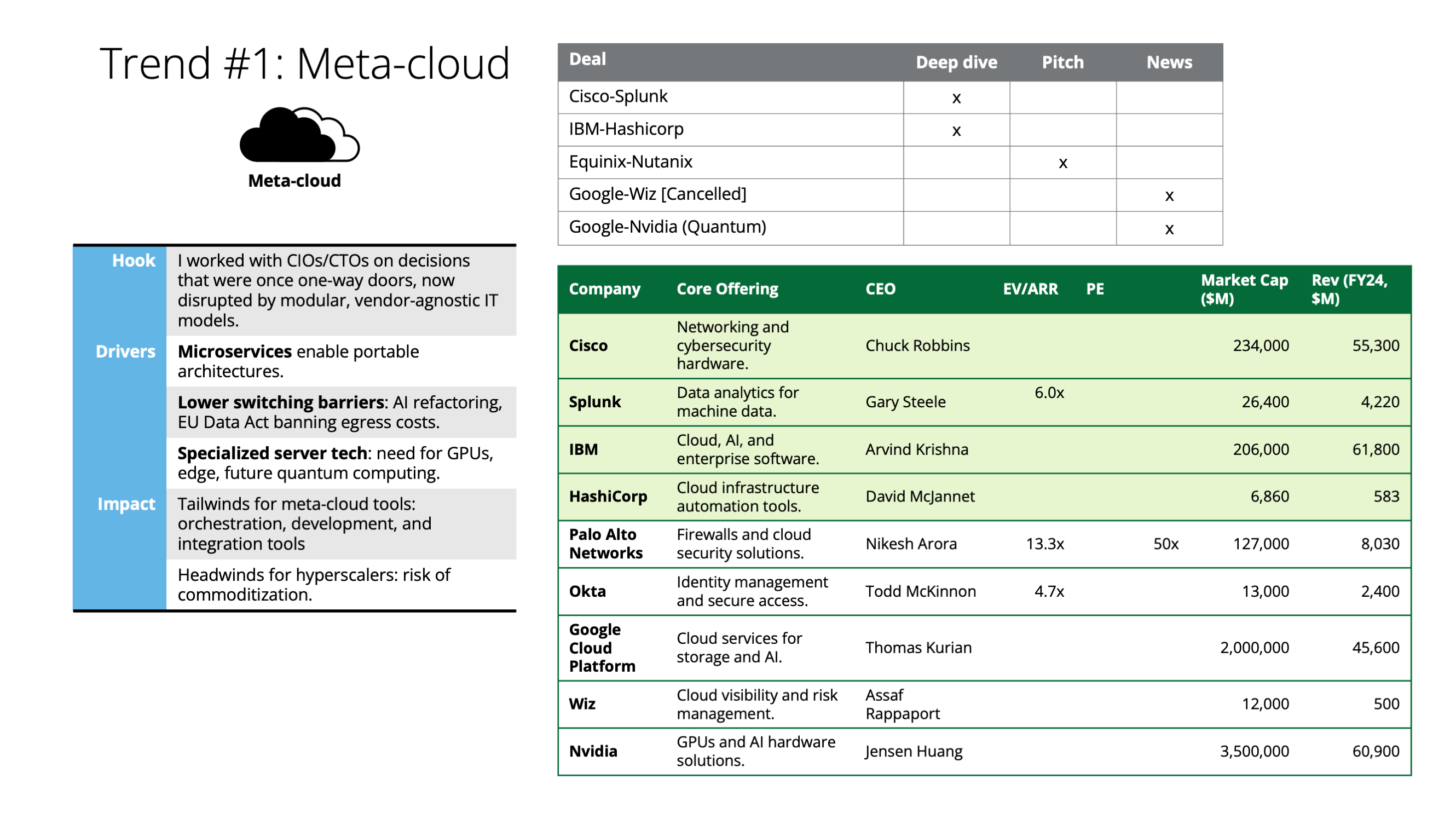 Trend cluster diagram showing meta-cloud drivers and impacts
Deal Selection
Find 2–3 deals. Memorize the details. Know the rationale cold.
Size and Structure: Target $1bn+ transactions. Avoid mega-deals (too common). Look for deals with multiple banks on both sides—interviewers appreciate when their firm advised.
Type: Strategic deals over sponsor-backed (unless interviewing for sponsor coverage). The rationale tends to be richer.
Required Knowledge: Valuation metrics, comparable transactions, deal structure, strategic thesis. If there was a fairness opinion or interesting financing, know it.
Deal Framework
Consolidate dry facts into a staccato opening, then pivot to insight.
| Slot | Content |
|---|
| Details | Acquirer & Target, Size & Premium, Multiple (Revenue/EBITDA), Cash vs. Stock |
| Hook | "I found this interesting because..." (Bridge to your cluster) |
| Rationale | Strategic: Synergies, defensive moves. Financial: Accretion, tax, cash use |
Example: IBM / HashiCorp
| Key | Value |
|---|
| Details | IBM acquired HashiCorp (April 2024) for $6.4bn, implying 12x EV/ARR and a 40% premium, in an all-cash transaction |
| Hook | I found this interesting because it was a defensive move to own the "meta-cloud" layer, directly validating the hybrid cloud trend I've been following |
| Rationale | Strategic: HashiCorp's Terraform is the standard for infrastructure-as-code; this prevents IBM from being locked out of multi-cloud workflows. Financial: While the 40% premium was steep, IBM leveraged its balance sheet to acquire a high-growth asset (35% YoY ARR) that was struggling with profitability (-8% Rule of 40) |
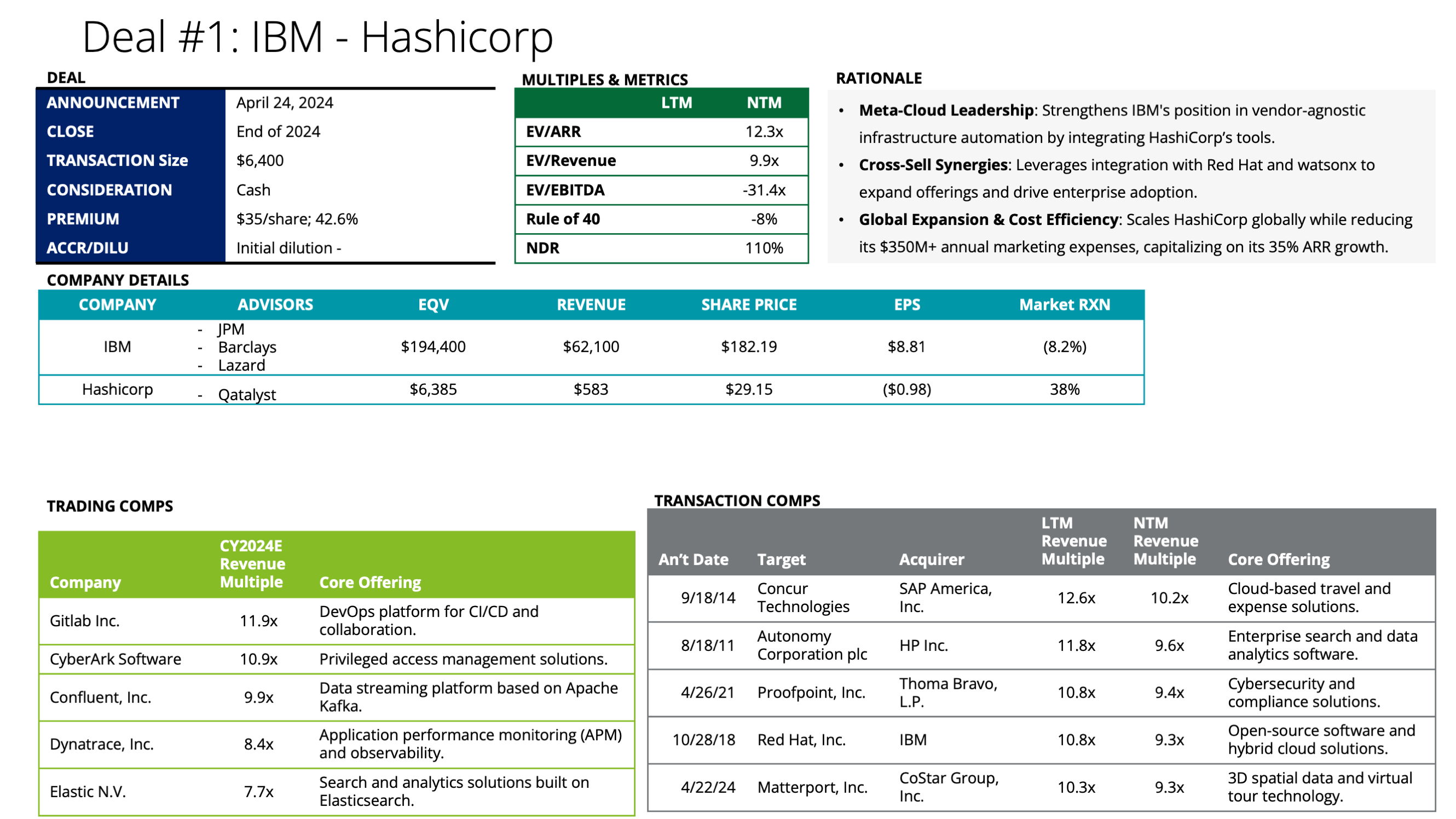 IBM / HashiCorp deal structure and rationale
Sample Delivery:
"I've been following IBM's acquisition of HashiCorp. IBM bought them in April 2024 for $6.4bn—roughly 12x ARR—paying a 40% premium in all cash."
"I found it interesting because it's a direct bet on the 'meta-cloud' thesis. Strategically, IBM needs to own the layer above AWS and Azure to stay relevant. Financially, they used cheap cash to pick up a high-growth asset that was temporarily undervalued due to profitability concerns."
Company Selection
After completing the above, note the companies that emerge. Every company answer should connect to a deal and a trend. This separates "I read the news" from "I have a worldview."
Coverage: Which verticals or end markets define its franchise?
Model: How does it make money—where's the margin or moat?
Momentum: Know recent earnings. If there was a call in the last quarter, know the headline and market reaction.
Company Framework
| Slot | Content |
|---|
| Business | Name & Sector, one-line business description |
| Financials | Market Cap, Valuation (EV/EBITDA, P/E), comparison vs. peers |
| Interest | 1. Transaction: Link to M&A. 2. Trend: Link to macro |
The "two reasons" structure forces connection to both a transaction and a trend—pulling the interviewer into your cluster regardless of which follow-up they choose.
Sample Delivery:
"HashiCorp is an infrastructure-as-code platform—Terraform is basically the industry standard for provisioning cloud resources. Market cap was around $5B before the deal, trading at ~8x NTM revenue, which was a discount to peers like Datadog."
"Two reasons they caught my attention. First, the IBM acquisition at $6.4bn—40% premium, all cash. That validated the standalone value and gave them enterprise distribution. Second, they're a pure play on the meta-cloud trend. As enterprises want portability across AWS, Azure, GCP, HashiCorp's tools become the connective tissue."
Preparation Notes:
- Have 2–3 companies ready, ideally connected to your deals and trends
- Financials should be approximate but credible—do not guess wildly
- The two "interest" points demonstrate connectivity and depth
- Be ready to defend pushback ("Why not Pulumi instead?")
Cluster Integration
Your cluster should feel like one story told three ways. Practice entering from each angle and threading back to the others.
| Entry Point | Thread To |
|---|
| Company | Mention the deal and the trend |
| Deal | Anchor in the trend and name the companies |
| Trend | Bring up the companies and deals proving it out |
The goal: Demonstrate you see how facts connect, not just that you know them.
The execution: Answer the question, then stop. Let them pull deeper. Never land somewhere outside your cluster.